
Thermal Mass Meter

A Thermal Mass Meter works by measuring the total mass flow rate of a fluid flowing through a pipe or duct.  In a thermal flowmeter’s simplest working configuration, fluid flows past a heated thermal sensor and a temperature sensor.  As the molecules of the fluid flow past the heated thermal sensor, heat is lost to the flowing fluid.

Thermal mass flow meters, also known as thermal dispersion or immersible mass flow meters comprise a family of instruments for the measurement of the total mass flow rate of a fluid, primarily gases, flowing through closed conduits.  A second type is the capillary-tube type of thermal mass flow meter.  Many mass flow controllers (MFC) which combine a mass flow meter, electronics and a valve are based on this design.  Furthermore, a thermal mass flow meter can be built by measuring temperature differential across a silicon-based MEMS chip.


This product is currently out of stock and unavailable.

Description

Thermal Mass MeterThe Thermal Mass Meter is widely used devices for measuring the flow rate of gases or liquids in various industries.  Also, these meters operate based on the principles of thermal conductivity and heat transfer.  In this response, I will aim to provide a comprehensive description of thermal mass flow meters, along with their advantages, disadvantages, and the industries in which they find application.

Thermal mass flow meters consist of a sensor that measures the heat dissipation or cooling effect caused by the fluid passing through the meter.  In addition, the rate of heat transfer is directly proportional to the mass flow rate.  Also, by accurately measuring the change in temperature of the fluid and utilizing the heat transfer principle, these meters determine the flow rate.

Contact Us For a Quote

Working Principle

Thermal mass flow meters work based on the principle of thermal conductivity.  Also, the meter consists of a sensor or probe that contains two temperature sensors: one measures the fluid’s temperature and the other acts as a reference sensor.  When the fluid flows through the meter, it comes into contact with the heated sensor.  In addition, as the fluid absorbs heat from the sensor, it causes a temperature difference between the two sensors.  finally, by analyzing this temperature difference, the meter determines the mass flow rate.

Sensor Types

There are two common types of thermal mass flow meters: Constant Temperature (CT) and Constant Heat (CH).

Constant Temperature (CT):

In CT thermal mass flow meters, the sensor heats up to maintain a constant temperature difference between the heated and reference sensors.  Moreover, as the fluid flows, it absorbs some of the heat, and the power required to maintain the temperature difference changes.  This power is proportional to the mass flow rate, allowing the meter to calculate the flow rate accurately.

Constant Heat (CH):

CH thermal mass flow meters operate by maintaining a constant heat input to the fluid.  In addition, the temperature difference between the sensors is measured, and the flow rate is determined based on the amount of heat required to maintain the temperature difference.

Applications and Benefits

Thermal mass flow meters find applications in various industries due to their unique characteristics and benefits:

Gas Flow Measurement:

These meters are widely used for measuring the flow rates of gases, such as natural gas, compressed air, and various hydrocarbon gases.  Furthermore, they provide accurate and reliable measurements for gas flow monitoring, custody transfer, and process control.

Liquid Flow Measurement:

Thermal mass flow meters can also measure the flow rates of liquids, making them suitable for liquid transfer and process applications.  However, they are primarily preferred for measuring gas flow due to their thermal properties.

Direct Mass Flow Measurement:

One of the primary advantages of thermal mass flow meters is that they provide direct mass flow measurement without the need for additional calculations or conversions.  This makes them highly accurate and eliminates the potential for errors associated with volumetric flow measurements.

Low Pressure Drop:

Thermal mass flow meters typically have a low pressure drop, meaning they cause minimal restriction to the fluid flow.  In addition, this characteristic is especially crucial in applications were maintaining system efficiency and reducing energy consumption is important.

Wide Rangeability:

These meters offer a wide rangeability or turndown ratio, allowing them to measure flows from very low to extremely high velocities accurately.  This flexibility makes them suitable for various flow rate requirements in different industries.

Low Maintenance:

Thermal mass flow meters are known for their durability and low maintenance requirements.  They have no moving parts or obstructions that can impede the flow or require frequent maintenance, leading to reduced downtime and increased operational efficiency.

It’s important to note that the specific features and capabilities of thermal mass flow meters can vary depending on the manufacturer and model.  Therefore, when selecting a thermal mass flow meter for a particular application, it’s essential to consider factors such as flow range, fluid properties, accuracy requirements, and environmental conditions to ensure optimal performance.

Insertion style Thermal Mass Meter:

Include a sensor & probe assembly that is inserted into the process gas flow conduit to allow the process gas to flow across the flow sensing elements.  Our insertion style flow meters are available with 3/4″, or 1″ OD probes.  Tube fittings and ball valve retractor assemblies, with or without a mounting flange, are also available from the factory as options.  The tube length must be specified upon ordering.  For other probe diameters and lengths, please consult the factory.

Integral style Thermal Mass Meter

have all of the electrical components and connections located within one enclosure.  The enclosure is mounted directly to the insertion probe assembly at the point of measurement.  The enclosure includes all of the electrical connections as well as the linearizing electronics and the display/keypad assembly.

Principle

Thermal mass meter uses the principle of convective heat transfer to directly measure mass flow.  ProFlow’s proprietary thermal mass flow sensors use two ratiometrically matched, reference-grade platinum Resistance Temperature Detectors (RTDs).  The platinum sensing element wire is encapsulated in a 316 Stainless Steel sheath or, if specified, a Hastelloy C sheath.  Our microcontroller operated smart sensor technology preferentially heats one RTD; the other RTD acts as the temperature reference.  The process gas flow dissipates heat from the first RTD.  This causes an increase in the power required to maintain a balance between the RTDs.  This increase is directly related to the gas molecular rate of flow.  Our sensors are temperature compensated for a wide process gas temperature range and insensitive to pressure changes.  This will confirm the output signal is a true mass flow rate signal.

In conclusion, thermal mass flow meters offer several advantages, including a wide range of measurements and direct mass flow measurement.  Other advantages are low pressure drop, high accuracy, and compatibility with various fluids.  However, they also have limitations related to gas composition changes, initial cost, and dependency on fluid properties.  Finally, these flow meters find applications in diverse industries such as oil and gas, chemical and petrochemical.  Other industries are HVAC systems, pharmaceutical and biotechnology, and food and beverage.  This is contributing to efficient and reliable flow rate measurements throughout these sectors.

Do you wish to purchase a Thermal Mass Meter?

Additional information

Weight 9 lbs
Dimensions 24 × 14 × 14 in
Size

3/4", 1", 1-1/2", 2", 3", 4"

Pressure Class

150LB, 300LB, 600LB

Connections

NPT, Flanged, Triclamp

Display

Yes, No

Voltage

24 VDC, 120 VAC

Communication Protocol

RS485, HART

Output

4-20 MA, 0-10 VDC

Classification

Explosion Proof, Intrinsically Safe

Specifications

Approvals:

Currently no product agency approvals.

Enclosure Certifications by manufacturer
CSA – CL. I. GR. A,B,C,D; CL. II. GR. E,F,G; CL. III.;TYPE 4X
US – CL. I. GR. A,B,C,D; CL. II. GR. E,F,G; CL. III.;TYPE 4X
IECEx – Ex d IIC Gb, Ex t IIIC Db, Exia (intrinsically safe)
ATEX – II 2G Ex IIC Gb, II 2Dd Ex t 111C Db

Linear signal output
0–5 VDC & 4–20 mA (Flow and Temperature)

Event Relay Rating one with Frequency or two, 1 Amp @ 30Vdc (33W)

Signal Interface
RS232 & RS485 Modbus RTU embedded, HART , LCD (flow rate, flow total, gas temperature)

Accuracy, including linearity (Ref.: 21°C)
±(1% of Reading + 0.5% of Full Scale + GTC)

Repeatability
±0.2% of Full Scale

Sensor response time
1 second to 63% of final value

Turn down ratio
100:1 @ 10 SFPM (.051 NMPS) Minimum Reading

Electronics PCB temperature range
-40° to 158°F (-40° to +70°C)

Environmental temperature range
-40° to 140°F (-40° to +60°C)

Gas temperature range
-40°–392°F (-40°–200°C)

Gas temperature coefficient (GTC)
0.02% Full Scale/°C

Gas pressure effect
Negligible over ± 20% of absolute calibration pressure

Pressure rating maximum
500 PSI Std.

Input power requirement
24VDC @ 250mA, 115 VAC 50/60 Hz optional, 230 VAC 50/60 Hz optional

Flow Transmitter power requirements
5 watts maximum

RAM Back-up
Lithium Battery

Wetted materials
316 Stainless Steel (Hastelloy optional)

Standard temperature & pressure (STP)
70°F & 29.92″ Hg (Air .075 lb./cubic foot)

NIST traceable calibration
Standard

NOTE: Specifications subject to change without notice.

Installation

Installing a thermal mass flow meter correctly is crucial for ensuring accurate measurements and reliable operation. Here’s a general procedure to follow:

Preparation

Read the Manual:

  • Before starting, thoroughly read the manufacturer’s installation manual. Each flow meter may have specific requirements.

Safety First:

  • Ensure that you have the necessary safety gear and are following all safety procedures, especially if you are working with hazardous fluids or high temperatures.

Check Compatibility:

  • Verify that the flow meter is compatible with the process conditions, including the type of fluid, temperature, pressure, and flow range.

Site Preparation

Location:

  • Choose a location that allows for easy access for maintenance and calibration. Ensure the area is free of vibrations, temperature extremes, and electromagnetic interference.

Pipe Size and Orientation:

  • Confirm that the flow meter is suitable for the pipe size and that it can be installed in the correct orientation (usually inline with the flow).

Cleanliness:

  • Ensure that the pipe and the area where the flow meter will be installed are clean and free of debris.

Installation

Turn Off and Depressurize:

  • Shut down the process and depressurize the pipe. If the fluid is hazardous, follow proper procedures for safe handling.

Pipe Preparation:

  • Clean the pipe ends where the flow meter will be installed. Remove any burrs or sharp edges to avoid damaging the flow meter.

Mounting the Flow Meter:

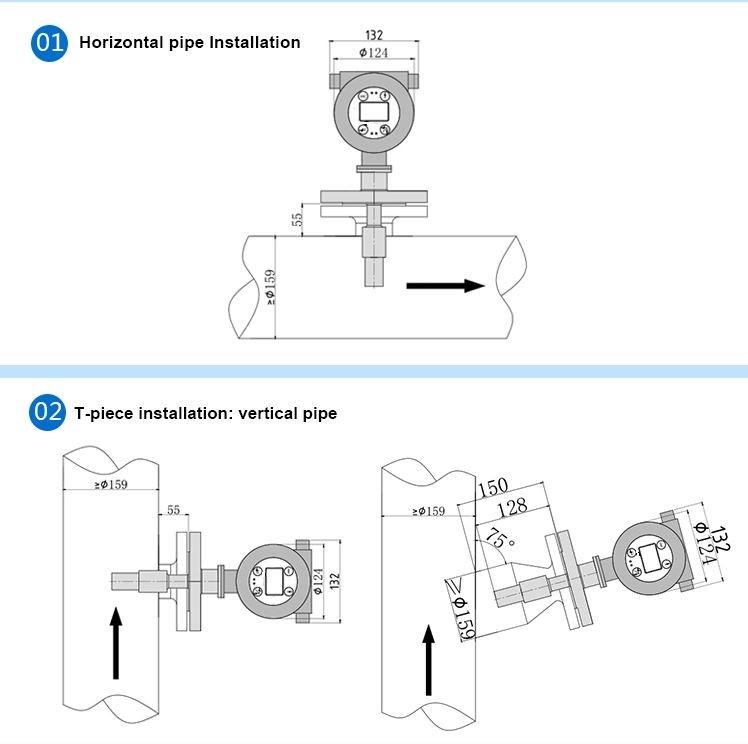
  • Inline Installation:
    • For inline installation, use the appropriate flanges, fittings, or clamps. Ensure that the flow meter is aligned with the pipe and securely fastened.
  • Insertion Installation:
    • If the flow meter is an insertion type, insert it into the pipe through the appropriate port. Use the provided clamps or fixtures to secure it.

Check Flow Direction:

  • Make sure the flow meter is installed in the correct direction. There should be an arrow or label indicating the direction of flow.

Electrical and Signal Connections:

  • Connect the flow meter’s electrical wiring and signal outputs according to the manufacturer’s instructions. Ensure all connections are secure and properly insulated.

Calibration and Testing:

  • After installation, calibrate the flow meter if required. Perform a test run to check for leaks and ensure the flow meter is functioning correctly.

Post-Installation

System Start-Up:

  • Slowly restart the process and monitor the flow meter for proper operation. Check for leaks and ensure that the readings are accurate.

Documentation:

  • Record the installation details, including the installation date, calibration settings, and any relevant observations.

Regular Maintenance:

  • Follow the manufacturer’s recommendations for regular maintenance and calibration to ensure continued accuracy and performance.

Troubleshooting Tips

  • Inaccurate Readings: Check for proper installation, leaks, and calibration issues.
  • Erratic Readings: Ensure that there are no obstructions or turbulence affecting the flow meter.
  • Leakage: Inspect all connections and seals to ensure they are secure.

Following these steps should help you install your thermal mass flow meter successfully and ensure it operates accurately. Always refer to the specific guidelines provided by the manufacturer for your particular model.

Maintenance

Maintaining a thermal mass flow meter is essential for ensuring its long-term accuracy and reliability.  Here’s a general maintenance procedure you can follow but be sure to consult the manufacturer’s guidelines for any model-specific recommendations.

Routine Inspection

Visual Check:

  • Frequency: Monthly or as recommended.
  • What to Look For: Inspect the flow meter for signs of physical damage, corrosion, or leaks.  Ensure that there are no loose connections or visible wear.

Verify Readings:

  • Frequency: Monthly or as part of a scheduled routine.
  • What to Check: Compare the flow meter readings with a known reference or another reliable measurement method to ensure accuracy.

Calibration

Regular Calibration:

  • Frequency:  Annually or per the manufacturer’s recommendation, or whenever a significant change in process conditions occurs.
  • Procedure:  Follow the manufacturer’s calibration instructions.  This often involves using a known standard flow rate and adjusting the meter to match it.

Post-Maintenance Calibration:

  • If any maintenance or repairs have been performed, recalibrate the meter to ensure continued accuracy.

Cleaning

Frequency:  As needed, depending on the process fluid and the level of contamination.

Procedure:

  • For Inline Meters:  If the flow meter has a self-cleaning function, ensure it is operational.  If not, you may need to remove the meter for cleaning.
  • For Insertion Meters:  Carefully remove the meter from the pipe and clean it according to the manufacturer’s instructions.  Use appropriate cleaning agents that are compatible with the meter’s materials and the process fluid.

Precautions: Always follow the manufacturer’s recommendations for cleaning agents and methods to avoid damaging the flow meter.

Checking and Tightening Connections

Frequency:  Quarterly or as part of a routine inspection.

Procedure:

  • Inspect all electrical and fluid connections to ensure they are secure.  Tighten any loose fittings or connections.  Be careful not to overtighten, as this could damage the threads or seals.

Software and Firmware Updates

Frequency:  As required or when updates are provided by the manufacturer.

Procedure:

  • Check for any available software or firmware updates for the flow meter.  Follow the manufacturer’s instructions for downloading and installing updates to ensure the meter’s functionality and compatibility with other systems.

Documentation and Records

Frequency: After each maintenance activity.

Procedure:

  • Maintain detailed records of all maintenance activities, including inspections, calibrations, cleanings, and repairs. Document the date, actions taken, and any observations or adjustments made.

Troubleshooting

Frequency: As needed.

Procedure:

  • Erratic Readings:  Check for obstructions, leaks, or turbulence.  Ensure that the meter is correctly calibrated.
  • Inaccurate Readings:  Recalibrate the meter and verify the process conditions.  Check for any installation issues or changes in the process fluid.
  • Mechanical Issues:  Inspect for signs of physical damage or wear.  If necessary, consult with the manufacturer or a qualified technician for repairs.

Professional Service

Frequency: As required or based on the manufacturer’s recommendations.

Procedure:

  • If you encounter persistent issues or complex problems, contact the manufacturer or a certified service technician for professional assistance and servicing.

Summary

  • Monthly:  Perform visual checks and verify readings.
  • Annually:  Calibrate the flow meter.
  • As Needed:  Clean the meter, check and tighten connections, and update software/firmware.
  • Documentation:  Keep detailed records of all maintenance activities.

By following these maintenance procedures, you can help ensure that your thermal mass flow meter continues to operate accurately and efficiently over its service life.

Q&A

Q:  What is a Thermal Mass Flow Meter?
A:  A Thermal Mass Flow Meter is a device used to measure the flow rate of a fluid by calculating the heat transfer from a heated sensor to the flowing fluid.

Q: How does a Thermal Mass Flow Meter work?
A:  The Thermal Mass Flow Meter works based on the principles of convective heat transfer.  The heated sensor within the meter measures the heat dissipation as the fluid passes over it, and this heat dissipation is directly proportional to the mass flow rate of the fluid.

Q: What are the advantages of using a Thermal Mass Flow Meter?
A: Some advantages of using a Thermal Mass Flow Meter include high accuracy, ability to measure low flow rates, minimal pressure drop, wide turndown ratio, and suitability for various types of gases.

Q: What are the applications of a Thermal Mass Flow Meter?
A: Thermal Mass Flow Meters are commonly used in industries such as oil and gas, chemical processing, pharmaceuticals, power generation, food and beverage, and HVAC systems to measure the flow of gases.

Q: How do you calibrate a Thermal Mass Flow Meter?
A: Calibration of a Thermal Mass Flow Meter involves comparing the meter readings to a reference standard. This is typically done by a certified calibration lab or using a calibration gas of known properties.

I hope this Q&A helps you understand more about Thermal Mass Flow Meters! If you have any specific questions or need more information, feel free to ask.

Advantages / Disadvantages

Advantages of Thermal Mass Flow Meters:

Wide Range of Measurements:

Thermal mass flow meters can accurately measure a broad range of flow rates, from low to high velocities, making them suitable for various applications.

Direct Mass Flow Measurement:

These meters provide direct measurement of mass flow rate, eliminating the need for additional calculations or conversions.

Low Pressure Drop:

Thermal mass flow meters have a relatively low pressure drop, minimizing the impact on the system’s overall performance.

High Accuracy:

Modern thermal mass flow meters offer exceptional accuracy, enabling precise measurement and control of fluid flow.

Compatibility:

These meters can handle a wide range of fluids, including gases and liquids, making them versatile for different industries.

Disadvantages of Thermal Mass Flow Meters

Limited Applicability to Gas Composition Changes:

Thermal mass flow meters are sensitive to variations in the composition of the gas being measured.  If the composition changes significantly, it may affect the accuracy of the measurement.

High Initial Cost:

Compared to some other flow meter technologies, thermal mass flow meters can have a higher initial cost.

Dependency on Fluid Properties:

Certain fluid properties, such as specific heat and thermal conductivity, can influence the accuracy of thermal mass flow meters.  Calibration may be required for different fluids or fluid compositions to ensure accurate readings.

Applications

Industries Utilizing Thermal Mass Flow Meters:
Oil and Gas:

Thermal mass flow meters are extensively used in the oil and gas industry for measuring the flow of natural gas, flare gas, compressed air, and various hydrocarbon gases.

Chemical and Petrochemical:

These meters find applications in the chemical and petrochemical industries for measuring gas flow rates in processes such as reactor feeding, gas blending, and combustion control.

HVAC Systems:

Thermal mass flow meters are commonly used in heating, ventilation, and air conditioning (HVAC) systems to measure airflow and monitor energy consumption.

Pharmaceutical and Biotechnology:

These industries utilize thermal mass flow meters for measuring gas and liquid flows.  This is commonly done during the production of pharmaceuticals and biotechnology products.

Food and Beverage:

Thermal mass flow meters play a crucial role in the food and beverage industry.  This is where they are used for measurements related to gas flow rates, liquid transfers, and process control during manufacturing processes.

Downloads

Drawings

You may also like

Translate »
news-1701

sabung ayam online

yakinjp

yakinjp

rtp yakinjp

slot thailand

yakinjp

yakinjp

yakin jp

yakinjp id

maujp

maujp

maujp

maujp

sabung ayam online

sabung ayam online

judi bola online

sabung ayam online

judi bola online

slot mahjong ways

slot mahjong

sabung ayam online

judi bola

live casino

sabung ayam online

judi bola

live casino

SGP Pools

slot mahjong

sabung ayam online

slot mahjong

SLOT THAILAND

118000731

118000732

118000733

118000734

118000735

118000736

118000737

118000738

118000739

118000740

118000741

118000742

118000743

118000744

118000745

118000746

118000747

118000748

118000749

118000750

118000751

118000752

118000753

118000754

118000755

118000756

118000757

118000758

118000759

118000760

118000761

118000762

118000763

118000764

118000765

138000451

138000452

138000453

138000454

138000455

138000456

138000457

138000458

138000459

138000460

138000461

138000462

138000463

138000464

138000465

138000466

138000467

138000468

138000469

138000470

138000471

138000472

138000473

138000474

138000475

138000476

138000477

138000478

138000479

138000480

158000346

158000347

158000348

158000349

158000350

158000351

158000352

158000353

158000354

158000355

158000356

158000357

158000358

158000359

158000360

158000361

158000362

158000363

158000364

158000365

158000366

158000367

158000368

158000369

158000370

158000371

158000372

158000373

158000374

158000375

158000376

158000377

158000378

158000379

158000380

158000381

158000382

158000383

158000384

158000385

208000381

208000382

208000383

208000384

208000385

208000386

208000387

208000388

208000389

208000390

208000391

208000392

208000393

208000394

208000395

208000396

208000397

208000398

208000399

208000400

208000401

208000402

208000403

208000404

208000405

208000406

208000407

208000408

208000409

208000410

228000116

228000117

228000118

228000119

228000120

228000121

228000122

228000123

228000124

228000125

228000126

228000127

228000128

228000129

228000130

228000131

228000132

228000133

228000134

228000135

228000136

228000137

228000138

228000139

228000140

228000141

228000142

228000143

228000144

228000145

228000146

228000147

228000148

228000149

228000150

228000151

228000152

228000153

228000154

228000155

228000156

228000157

228000158

228000159

228000160

228000161

228000162

228000163

228000164

228000165

228000166

228000167

228000168

228000169

228000170

228000171

228000172

228000173

228000174

228000175

228000176

228000177

228000178

228000179

228000180

228000181

228000182

228000183

228000184

228000185

228000186

228000187

228000188

228000189

228000190

228000191

228000192

228000193

228000194

228000195

228000196

228000197

228000198

228000199

228000200

228000201

228000202

228000203

228000204

228000205

228000206

228000207

228000208

228000209

228000210

228000211

228000212

228000213

228000214

228000215

238000217

238000218

238000219

238000220

238000221

238000222

238000223

238000224

238000225

238000226

238000227

238000228

238000229

238000230

238000237

238000238

238000239

238000240

238000241

238000242

238000243

238000244

238000245

238000246

238000247

238000248

238000249

238000250

238000251

238000252

238000253

238000254

238000255

238000256

news-1701
news-1701

yakinjp


sabung ayam online

yakinjp

yakinjp

rtp yakinjp

yakinjp

judi bola online

slot thailand

yakinjp

yakinjp

yakin jp

ayowin

yakinjp id

mahjong ways 2

JUDI BOLA ONLINE

maujp

maujp

sabung ayam online

sv388

taruhan bola online

maujp

maujp

maujp

maujp

sabung ayam online

sabung ayam online

sabung ayam online

judi bola online

sabung ayam online

judi bola online

slot mahjong ways

slot mahjong

118000451

118000452

118000453

118000454

118000455

118000456

118000457

118000458

118000459

118000460

118000461

118000462

118000463

118000464

118000465

118000466

118000467

118000468

118000469

118000470

118000471

118000472

118000473

118000474

118000475

118000476

118000477

118000478

118000479

118000480

118000481

118000482

118000483

118000484

118000485

118000486

118000487

118000488

118000489

118000490

128000531

128000532

128000533

128000534

128000535

128000536

128000537

128000538

128000539

128000540

128000541

128000542

128000543

128000544

128000545

208000221

208000222

208000223

208000224

208000225

128000546

128000547

128000548

128000549

128000550

128000551

128000552

128000553

128000554

128000555

138000371

138000372

138000373

138000374

138000375

138000376

138000377

138000378

138000379

138000380

138000381

138000382

138000383

138000384

138000385

138000386

138000387

138000388

138000389

138000390

138000391

138000392

138000393

138000394

138000395

138000396

138000397

138000398

138000399

138000400

138000401

138000402

138000403

138000404

138000405

138000406

138000407

138000408

138000409

138000410

138000411

138000412

138000413

138000414

138000415

158000296

158000297

158000298

158000299

158000300

158000301

158000302

158000303

158000304

158000305

158000306

158000307

158000308

158000309

158000310

158000311

158000312

158000313

158000314

158000315

158000316

158000317

158000318

158000319

158000320

158000321

158000322

158000323

158000324

158000325

158000326

158000327

158000328

158000329

158000330

158000331

158000332

158000333

158000334

158000335

178000726

178000727

178000728

178000729

178000730

178000731

178000732

178000733

178000734

178000735

178000736

178000737

178000738

178000739

178000740

178000741

178000742

178000743

178000744

178000745

178000746

178000747

178000748

178000749

178000750

178000751

178000752

178000753

178000754

178000755

208000196

208000197

208000198

208000199

208000200

208000201

208000202

208000203

208000204

208000205

208000206

208000207

208000208

208000209

208000210

208000211

208000212

208000213

208000214

208000215

208000216

208000217

208000218

208000219

208000220

228000376

228000377

228000378

228000379

228000380

228000381

228000382

228000383

228000384

228000385

228000386

228000387

228000388

228000389

228000390

238000551

238000552

238000553

238000554

238000555

238000556

238000557

238000558

238000559

238000560

238000561

238000562

238000563

238000564

238000565

238000566

238000567

238000568

238000569

238000570

news-1701